Sunday, December 6, 2009

Week 8: More El Sistema on the Brain - Learning, Doing, Being

The power of social interaction cannot be underestimated. I’ve seen the important role it plays in the success of El Sistema through the orchestra, as well as  how it’s helped inform my thinking through group discussion in the Abreu Fellowship and through this blog. 

For example, I’d like to thank Sasuzukistrings for her thoughtful responses to several of my blog postings.  A couple weeks ago, she shared the link to an interview with Adele Diamond on Learning, Doing, Being:  A New Science of Education aired on NPR’s Speaking of Faith program.  Adele Diamond, Professor in Developmental Cognitive Neuroscience at the University of British Columbia, shared her research on the educational power of play, music, memorization, joy and social interaction.

She attributes how well we learn and apply this learning to the brain’s executive function.  Housed in the pre-frontal cortex, the executive function is responsible for:
  1. Inhibitory control:  ability to stop, reflect and control first impulses
  2. Working memory:  hold information in the mind long enough to creatively manipulate it
  3. Cognitive flexibility: think outside the box and flexibly adjust when needed
What was most exciting is that she specifically mentions El Sistema as a model program that develops this important function of the brain, as well as incorporates the other brain nutrients of play, memorization, social interaction and joy:
El Sistema addresses all parts of the human being (physical visual coordination, exercises executive functions – sustains attention, holds sequences in mind.) It addresses your emotions, with joy in mind, gives you self-confidence and pride, you feel like you’re a member of a social group, where everybody collaborates.  You’re an important part of this group.  I would love to see research on this!
Even though Adele has helped address the question I posed in my last blog posting, “How can the intuitive and elusive spark of El Sistema be translated into more scientific language for the United States?” her call for more specific research on El Sistema is noted and perhaps could be a piece that the Abreu Fellows help undertake when we travel to Venezuela for two months to observe and document this inspiring program.

I’d like to thank everyone who has posted comments on my blog.  I learn from your ideas, questions and perspectives. Keep sharing!

Here is the link to hear Adele Diamond’s interview on NPR in its entirety.


Monday, November 30, 2009

Week 7: El Sistema on the Brain - A Meeting of Two Minds


How can the intuitive and elusive spark of El Sistema be translated into more scientific language for the United States where data drives funding priorities and dictates the way in which a program is valued? 

Even though this is a question that I hope to answer throughout my fellowship studies and observations, a recent webinar funded through the Juneau School District and Association of Alaska School Boards started me on my path. The presenter of the webinar, Eric Jensen who is an author of many brain-based books, led a group of Alaskan teachers and administrators through the research referenced in his book Teaching with Poverty in Mind.  With a new lens called El Sistema, I was able to connect many of its principles with Jensen’s findings, as well as with his recommendations for schools to help children in poverty. 

Keep in mind this was a 6-hour webinar, so I will bullet the main points and recommend reading his book for more details.  I hope it will help bridge what El Sistema has discovered intuitively with the scientific research valued by the US.  Here it goes!

Jensen lists the reasons why kids from a low socio-economic status (SES) underperform: 
  • Chronic stressors
  • Lack of positive role model
  • Ineffective teaching
  • Lack of comprehensive support
  • Lack of quality relationships
  • Little or no hope
The good news is that schools can reverse this process by targeting what Jensen calls SHARE or the Poverty Solution Model: Skill-building, Hope, Accommodations, Relationships and Enrichment.  Here are a few specifics for each:

S = SKILL-BUILDING: develop memory, processing and sequencing skills through activities that incorporate student relevance, focused attention, built-in feedback, last 30-90 min/day and occur 3-6 times/week.

H = HOPE for the future through long-term effort, delayed gratification, and setting and getting goals;

A = ACCOMMODATIONS as needed with food, transportation, health care, activities, people and places;

R = RELATIONSHIPS are stable and positive, include mentors and positive role models; and

E = ENRICHMENT is daily, constant, challenging and meaningful with plenty of social interaction.

Jensen's SHARE model easily translates into El Sistema philosophy.  Music-making naturally develops memory, sequencing and processing skills.  In an El Sistema model, this highly motivating activity happens consistently with lots of social interaction, peer mentoring and hope-building through long-term effort.   Accommodations, such as free transportation, instruments and music instruction, make this incredible world accessible to everyone.  Jensen summarizes his presentation with these four powerful statements, which have El Sistema principles written all over them:

  1. Effort and Emotional IQ matters more than IQ in predicting achievement
  2. Schools need to be in the business of building hope and positive social interaction.
  1. High-performing schools excel at developing these three Primary Shapers or Drivers of Achievement::
  • Relationships: intensity and reliability of specific attachments, including adult and peer mentors.
  • Social Status:  differentiating oneself from others and feeling special.
  • Socialization:  gaining the group’s acceptance and feeling part of a team
  1. “Arts support the development of critical neurobiological systems, which enhance improved attentional, social, cognitive, academic and cultural outcomes across ALL subject areas.”

      Saturday, November 21, 2009

      Week 6: On-Site Visits to Boston Music Programs

      This week, as part of our on-site visits to arts programs in Boston, the fellows visited the Conservatory Lab Charter School, which Larry Scripp, faculty member at NEC, helped charter. I shared his model Learning Through Music (LTM) model in my last posting. The school is very interested in starting an El Sistema program there next year and already has music woven throughout their curriculum. The school has a Learning through Music coordinator, general music teacher and a Suzuki string teacher who works with all students grades 1st through 5th grades. 

      The Learning Through Music teacher works very much like the visual arts teacher in our Art is Elementary program at Glacier Valley, but the medium is music. She works collaboratively with the classroom teacher to apply music skills to other content areas as a way to build multiple pathways of understanding and deepen knowledge and comprehension. I'm very interested in following-up with the three music specialists to learn how their work supports each other and how they work with classroom teachers to provide a comprehensive and cohesive music literacy program. Our time was short, but the fellows were able to share a couple of songs and a dance at an informal gathering with several classrooms (see Rebecca Levi's posting which includes a video clip).  

      As part of our site visits to other vibrant arts programs in the Boston community, the Abreu Fellows participated in a Boston City Singers choir and Suzuki violin rehearsal.  This program provides comprehensive music training for students grades K-12 at no cost.  Linda Money, the Artistic Director, and other key members of the program treated the fellows to a homemade dinner afterward, where we could informally share ideas and ask more questions about the program.  Both the rehearsal process and the dinner conveyed a warmth and family feel that explains why so many children remain in the program throughout their K-12 schooling.  Thank you, Linda, and the Boston City Singers community for your generous hospitality.


      Homemade Dinner with Members of the Boston City Singers

      We also visited the Boston Children's Chorus as part of our time with Anthony Trecek-King who taught us basic choral conducting skills and rehearsal techniques.  When observing the choirs, we experienced first-hand how Anthony and his staff lay the foundation for and help their singers achieve musical literacy.


      Michelle Adams prepares the intermediate choirs for their performance at this week's tree-lighting ceremony

      Thank you to Tanya Maggi, Director of NEC's Community Performances and Partnerships program, for arranging our visits to the other inspiring arts programs in Boston:

      The Power of Three: Learning Through Music

      In an earlier post, I shared Yo-Yo Ma’s triangle: Reception, Communication and Content and how the three need to intersect in order for “magic” to happen. The use of triangles to represent conceptual models seems to thread throughout this program.  I decided to explore the symbolism behind this common shape. Interestingly, triangles represent some very important ideals: balance, strength and stability.

      Larry Scripp, faculty member at New England Conservatory, bases his Music in Education model upon the triangular interplay of teacher, artist and scholar. Together all three can help transform education through engaging and authentic learning practices (teacher), aesthetic approaches to communicate learning (artist) and on-going evaluation to document effectiveness (scholar). Larry advocates for schools to hold music literacy as highly as it does language literacy, because the two mutually support each other.

      Larry has built a network throughout the country called the Music in Education National Consortium (MIENC) in which schools are partnering with university and arts organizations to help bring an interdisciplinary approach to teaching through the Learning Through Music (LTM) model.  Here is a short video providing an overview of MIENC:


      The five skills and their corresponding outcomes that Learning Through Music schools teach are:

      1. Listen = Listener/Perceiver
      2. Question = Questioner/Investigator
      3. Create = Creator/Inventor
      4. Perform = Performer/Interpreter
      5. Reflect = Reflective/Thinker
      Fittingly, these five processes help nurture the scholar, teacher and artist in each and every student. What a beautiful goal for a school to have and the kind of citizen a community would want! 

      As part of my work in the Abreu Fellowship, I will be focusing my energies on El Sistema pedagogy, curriculum and how the two translate to music education in the United States.   Larry Scripp's Learning through Music model provides a framework for addressing music literacy, as well as the National Standards for Music Education and will play an important role in the work I do in the area of curriculum development.   Thank you, Larry, for providing the Abreu Fellows with so many resources, research and meeting time to help digest the incredible work you have done.

      Saturday, November 14, 2009

      Week 5: Visiting ORCHKids in Baltimore

      "Start them early!" This El Sistema approach toward instrumental instruction came to life when I visited the ORCHKids program in Baltimore this past week where all kindergartners learn how to play the violin as part of their school day. They first begin with a "Paper Orchestra" (see photo from Sistema Scotland) to help master the physical challenges of holding and playing the instrument without fear of breaking it, but then quickly transition to the real thing.

      Early instrumental instruction accessible to all students is a model that I would like to bring back to Juneau. It ensures access for all students by offering violin instruction during the school day and then transitioning to after-school in the 1st grade. A kindergarten strings class also provides a developmentally appropriate intervention to support mental discipline, focus and improved memory. Research studies show that early musical training affects brain development in young children: "After one year the musically trained children performed better in a memory test that is correlated with general intelligence skills such as literacy, verbal memory, visiospatial processing, mathematics and IQ." Here is the link to the article from ScienceDaily.

      Dan Trahey, the director of the ORCHKids program, shared with the fellows a classroom violin storage unit on wheels that they had custom-made to help cut down on transition time, as well as avoiding those opportunities for violins to break when children are taking them in and out of their cases. This would be a must for Juneau!

      With so much footage from the week, I was inspired to attempt my first video documentation using my new Flip camera, iPhone and newest version of iMovie. This short documentary is posted below.  I hope you like it! I included some information that I learned from Eric Jensen's webinar on Teaching with Poverty in Mind.  The three main components that Jensen recommends all schools include to support children in poverty are evident in both the ORCHKids and El Sistema programs:  Relationships, Socialization and Social Status.  My Abreu Fellow, Dantes Rameau, made several postings about our visit to Batlimore if you'd like to read more.  Thank you, Lockerman-Bundy Elementary School, ORCHKids and World in Motion for welcoming the Abreu Fellows into your program this past week. I can't tell you how gratifying it was to be working with kids again! Hope you enjoy this short video:


      Saturday, November 7, 2009

      Week 4: Yo-Yo Ma and Making Moments Memorable


      Many years ago, I had the opportunity to hear Yo-Yo Ma perform in Beijing when I was an undergraduate student studying Chinese.  I still have the program from that concert with his autograph.  I can remember vividly meeting Yo-Yo Ma backstage, exchanging a few words in Mandarin before spilling into English to try to convey to him how much his performance meant to me. What a memorable moment!

      Who could have guessed that our next meeting would occur 20 years later at NEC through the Abreu Fellows program?  He is as generous and approachable as that time in China, and the moment was just as memorable.  Fittingly, he spoke about the importance of making moments memorable:  both as teachers and performers.  The two are inextricably linked because building trust is at their core. 

      He drew a triangle on the board labeling each vertex with the words Content, Communication and Reception.  When these three things are aligned, he explained, “You get magic.”  They are all interconnected, like a circuit. If the three are not in balance, the electricity won’t flow.  But when all three come together, a new spark or “recreation of a moment” occurs.  His message to us:  make everything you do memorable to help your students become curious, passionate, have disciplined imagination and empathy – the purpose of music.

      I had a chance to see this concept played out in Ben Zander's Music Interpretation class this week, when a NEC cellist performed a Bach prelude for the class.  This talented young musician played beautifully, and I couldn't imagine how her performance could be improved upon.  But Ben, who invites his students to work in the realm of possibility, wanted to help balance her mastery of Content with the other key points in Yo-Yo Ma's triangle:  Communication and Reception.  "Examine the architecture of the music so that you can better communicate the music to your audience. Be open to telling the story of the music; not your story, but the music's story."  He asked her to play the music's story to a guest from Pepperdine University who is enrolled in a doctoral program in Education and Psychology.  Attending one of Ben Zander's classes is part of their leadership course curriculum.

      What transpired was the "spark" or "recreation of a moment" that Yo-Yo Ma had been talking about earlier in the week. Everyone in the class, especially our Pepperdine visitor, heard and felt what Ben later described as "the beauty we achieve when we give up ourselves." Thank you, Yo-Yo Ma and Ben Zander! You are indeed makers of memorable moments.

      Saturday, October 31, 2009

      Thank you, World Music Drumming and Remo, Inc. for Your Donation!

      In just two weeks, I have been humbled by the generosity of so many people who have given their time and talents to help this program and its fellows be successful.  Will Schmid and Remo Belli are among this amazing group of people.  In many ways, their story encapsulates the collaborative energy behind the El Sistema USA initiative:

      After one e-mail explaining to Will the El Sistema USA program, the Abreu Fellows now have a 40-instrument World Drumming set coming our way to Boston with curriculum to explore, experience and consider incorporating into future El Sistema initiatives in the US.  Once I complete the fellowship in June, I will return to Juneau with these instruments and materials to put into the hands of children as part my program there.

      Here’s how it all began: 

      This past summer, I had the incredible experience of taking Will Schmid’s World Music Drumming class (see photo) in Wisconsin with hundreds of educators across the country. 

      Will has developed a drumming ensemble curriculum in collaboration with Remo, Inc., which addresses national music standards while filling classrooms with joyous drumming and singing.  His summer workshops are packed with drumming technique, repertoire and ensemble skills, as well as the infusion of recorder, dance and song  I came away equipped with effective teaching techniques, confidence leading a drum ensemble and a community of newly formed friendships.  

      When I learned that I would be participating in a fellowship aimed at bringing El Sistema to the US, I immediately thought of Will Schmid’s World Music Drumming curriculum.  The work Will and Remo have done embodies so much of El Sistema’s principles:  joyful music making through ensemble, using complex repertoire and incorporating folk music from the Americas.  This collaborative effort, which shares similar values as El Sistema, is an example of how meaningful work already done in the US can be an integral part of the future work we do.   Together we will accomplish incredible opportunities for our kids. 

      Thank you, Will and Remo, for the work you have already done for kids and music education programs across the country through World Music Drumming.  We look forward to future endeavors together!

      Week 3: Four Music Pedagogies and the Elephant

      This week’s emphasis on music pedagogy gave me the unique opportunity to compare and contrast four influential philosophies:  Dalcroze, Kodaly, Orff-Schulwerk and Suzuki.  After experiencing all four, I came away wondering why these pedagogies haven’t joined forces.   They all support a holistic approach to music, just disagree over which element is most fundamental:  movement, singing/solfege, improvisation or music-making.

      DALCROZE: Even though the other methods incorporate movement as part of their pedagogy, Dalcroze places movement as central to its teaching.  Lisa Parked, Director of Dalcroze Certification and Masters Degree program at Longy School of Music explained the three branches of the Dalcroze approach:
      • eurhythmics
      • active listening
      • improvisation and
      • solfege using a fixed "do" system (read more under Kodaly)
      Eurythmics is described as using the body as the “principal instrument of musical expression and response.”  While Lisa improvised on the piano, we responded to her changes in tempo, rhythm and mood by either skipping, running or moving slowly like an astronaut in space.  Lisa made improvisation seem natural.  As a classically trained piano student, improvisation was not an option and slowly drilled out of me; but during this Dalcroze class, Lisa made improvising seem effortless.  All of our creations sounded beautiful and fit nicely into an orchestration, conducted by Jonathan.
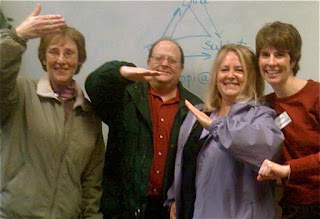
      KODALY: Kodaly is based on the belief that music literacy is the right of every human being.

      Mary Epstein and Jonathan Rappaport, Co-Directors of NEC's Kodaly Music Institute demonstrated through singing and listening games how anyone who can read is capable of reading music.  Even more compelling was the video documentation of Wendy Silverberg's classroom in a Cambridge public school over a three-year period.  Wow, those 2nd graders put the Abreu Fellow's solfege skills to shame! (See photo above of Wendy, Jonathan, Mary and me demonstrating our solfege hand signs).

      Music learning, in the Kodaly-inspired classroom, focuses on:
      • singing and dancing quality folk songs
      • movement
      • move-able solfege "do" system. 
      Where Dalcroze sees movement as central to its approach, singing is the foundation of the Kodaly method. Interestingly, they share many things in common:  both Dalcroze and Kodaly emphasize experience first, intellectualize or notate later.  They also honor each other by borrowing key principles from one another.  Dalcroze incorporates Kodaly’s solfege system, while Kodaly relies heavily on movement through the lens of folk dances to teach rhythm. They do differ in their approach to a fixed vs. moveable “do” system; Dalcroze supports a fixed “do” and Kodaly, a moveable one.  The latter stresses the importance of tonal function and relationships, while the former, pitch and notation.  It’s a debate that still rages on!

      ORFF SCHULWERK: Orff also incorporates many of the principles of the methods we explored during the week:
      • atmosphere of play
      • improvisation,
      • folk songs/chanting and
      • movement.
      In particular, Orff emphasizes music connected with speech, movement, percussion instruments and the importance of improvisation structured through musical form.  Through Orff-inspired lessons, Ruth Debrot, a music specialist in the Sharon Public Schools reminded us how beautiful simplicity can be.  She modeled how the creation of a 4-beat pattern can be the launching point for wonderfully woven extensions – ostinati, forms, improvisations, speech patterns, and dance.  Through well-scaffolded lessons, guiding questions and humor, she created a safe environment for creative expression.  We moved to scarves, created our own Rondo form to Peas, Porridge Hot and ended the session with an orchestration of Ruth's composition, Nino Querido.

      SUZUKI: Linda Fiore, Director of the Ogontz Suzuki Institute, studied with Suzuki in Japan and shared his guiding principles with us:
      • nurturing environment
      •  parent involvement, 
      • starting early, 
      • playing together and 
      • repetition through active listening. 

       Abreu Fellows taking a playful moment from their Suzuki instruction with Katie

      Dr. Suzuki based music instruction on the same sequence of language acquisition:  listen, imitate, play (speak) and then read music.  His belief was that every child is capable of high musical achievement; rather than trying to produce musical prodigies, his goal was to nurture a “noble heart.”  He carefully selected and sequenced real repertoire so that students learn skills in small steps within an authentic musical context.  Linda shared her indispensable bag of tricks to help teach difficult skills through early childhood practices:  carpet squares to help identify personal space, dowel rods toilet paper rolls to practice bowing, paint swatches and different colored fabrics to explore dynamics and mood.

      THE ELEPHANT:  Much like the story of the Five Blind Men and the Elephant, these four approaches shouldn’t lose the big picture in music education:  child-centered approaches infused with ensemble and joyful music-making.  

      This theme kept emerging throughout the week’s sessions and not surprisingly, is a recurring theme in the work of El Sistema. As we continue our work in the Abreu Fellowship, I am constantly drawn to the possibilities of partnership with organizations and people who have already done meaningful work in the US and who share similar philosophies.  Significant impact happens when we work together.  Thank you,  presenters, for helping to start the conversation.

      Sunday, October 25, 2009

      A Musical Feast - New England Style

      In just one week I:

      NEC Philharmonia warming up for Wayne Shorter Quartet

      Only in a city like Boston would you find such an incredible variety of music, right?  No, not exactly.  Even in Juneau, a community with a population of only 30,711, you are often faced with making difficult choices: musical theatre or the symphony, salsa dancing or a play, opera or a Celtic rock band?

      With all of these wonderful offerings, I’m reminded of the value-based question Ben Cameron asked us on Friday:  How will my community be affected if it is deprived of music tomorrow? For Juneau, it would devastate a community who often relies on music and the arts to uplift, connect and sustain us.  I feel very fortunate to be a part of the El Sistema USA initiative and what it will mean for children in Juneau, as well as communities all across the US.

      Music produces a kind of pleasure which human nature cannot do without. ~ Confucius


      Thank you, Mary Epstein and Carolyn Colby, for making sure that Rebecca and I could attend the Kodaly dance and singing games workshop presented by the Amidon’s. We will definitely share what we learned with the other fellows (top right photo)

      Thank you, Mark Churchill and Sean Hagon, for connecting me with the NEC Gospel Choir (2nd & 3rd photos on right).

      Thank you Mark Leach, for the incredible gift you gave me in the form of a ticket to the Wayne Shorter Quintet and Orchestra concert.  It was wonderful meeting you and your son.

      Thank you, Juneau, for providing so many opportunities for me to play and perform (photo below)

      Saturday, October 24, 2009

      Week 2: Key of C's or Knowing Your Core Values

      How does one synthesize a week filled with such diverse topics as leadership, community partnerships and the inner-workings of a successful El Sistema initiative in Baltimore?  Two Words: Core Values

      In the spirit of the Harlem Children’s Zone where organizations are “creating an interlocking web of services” to meet the needs of all of its children, Ben Cameron, Program Director of Arts at the Doris Duke Charitable Foundation; Daphne Griffin, Executive Director of the Boston Centers for Youth & Families; and Tanya Maggi, Director of Performance Outreach at New England Conservatory; all stressed how important it is for an organization to define its core values and then seek partnerships whose values intersect.

      These are the value-based questions that Ben (in photo left with Ben Zander and Mark Churchill) asks arts organizations to help them better define their role in their communities:
      1. What is the value of my program to the community?
      2. What is the value my program alone brings better than anyone else?
      3. How will my community be affected if it is deprived of music tomorrow?
      4. How does my organization optimally structure itself and its behavior to become the best conduit of music education and social change for my community?                
      Ben drives home the point that people are not asking about the quality of the arts, they are asking about its value. Value precedes quality and drives funding priorities.

      Dan Trahey who helped start an El Sistema initiative in Baltimore, called the ORCHKids program, proves Ben's point. His program provides snacks, academic tutoring and instrumental music for children Pre-K through 2nd grades.  The program has a successful partnership with the Baltimore School District because their values intersect and are expressed in this ORCHKids mission statement:

      “Create an after-school program devoted to music appreciation, academics, citizenship, community awareness, family and health (emotional, social and physical).”

      ORCHKids takes place during and after school and continues to expand:  testimony of how much the program is valued by the community.  Orchestra is seen as a metaphor for an ideal society – each member is valued, strives together through teamwork and beautifully communicate a shared vision through diverse voices.  Watch a short video about the ORCHKids program and its accomplishments.

      As I looked over the key elements of the El Sistema program and reflected on the values of my own community of Juneau, I began developing a list of core values or “Key of C’s”:
      • Child First, Music Second: every child is an asset and deserves access to the lifelong social, emotional and academic benefits that music provides, regardless of their financial means.
      • Community Building through ensemble, peer mentoring and community partnerships to help students reach their potential and become contributing members of society.
      • Consistency of Program: start early and everyday so that students have a daily haven of safety, joy and sense of value.
      • Challenge: through discipline and teamwork, students strive together to master difficult works.
      • Classical and Culturally Relevant Repertoire is emphasized to respect the contributions of a diversely rich community.
      • Child-Centered: instruction engages the whole child through movement and joyful music-making.
      This is still a work in progress, but certainly one I hope to develop in collaboration with the folks and organizations in Juneau.  Together, we can create an "interlocking web of services" to meet the needs of our children.

      Saturday, October 17, 2009

      Whirlwind Week 1: Focus on El Sistema's Key Elements

      How do we capture the unique qualities of El Sistema and translate them here in the U.S.? That was the big question permeating our discussions this week led by incredible presenters:

      On Wednesday, Anne Fitzgibbon who traveled to Venezuela as a Fulbright Scholar and started an El Sistema initiative in the US called the Harmony Program in Brooklyn, New York, shared her key elements:

      • Intensity of Study:  students start as early as age three and attend the conservatory every day after school.
      • Supportive Culture:  extraordinary relationship between teacher and students, as well as student to student.  Everybody is on the same team.
      • Emphasis on Ensemble:  students feel important and have fun through peer interaction and mentoring. Movement is embedded in everything they do.  They play joyfully; they have fun.

      On Thursday, Eric Booth, who wears many hats including author of the book, The Music Teaching Artist’s Bible, helped the fellows brainstorm our own list of El Sistema key elements (see photo).  In addition to Anne’s list we added:
      • Child First, Music Second
      • Sustainable through Consistent Funding
      • Emphasis on Performance 
      • Passion before Precision
      • Flexible Model with Clear Vision
      • Access to All Students 
      • Family and Community Inclusion
      • Every Child is an Asset and has the Capacity to Learn 
      • Mix of Classical and Folk Music
      On Friday, El Sistema graduates studying in the US provided an informal round table discussion, allowing us to ask questions about their experiences as children participating in Venezuela’s El Sistema program (see photo below).  They were very patient with us and after three hours of questions were able to help us hone in on what they thought made El Sistema unique and successful:
        • Camaraderie: students and teachers are a family
        • Consistency and Intensity of Program: rehearsals every day for at least four hours 
        • Use of Movement as Teaching Method: having movement as part of their lessons helped them stay motivated and instilled a sense of play. 
        • Seminars:  each nucleo would have the opportunity to travel, visit and play with students from other nucleos.  Each seminar lasted one or two weeks and was obvious by our visitors’ enthusiastic responses that it was key to the program. 
        • Competition or “to strive with”: students worked hard to advance to the next orchestra level, because it meant more challenging music, performances and travel.
        The week ended very much like it began:  being inspired by Ben Zander.  Instead of his “home” in Jordan Hall where I watched him conduct the Boston Philharmonic last weekend, Ben hosted an evening at his home in Cambridge for many people key to making the El Sistema USA program a reality, including Anna and Amy from the TED organization.  Ben shared dinner, conversation and inspiring stories about his life.  I am thrilled to be able to participate in his Music Interpretation class each Friday, one of the most popular classes at NEC! Not only does he model how music is an art form; but equally important, how teaching is an art form.  You can watch his inspiring talk on TED about music and passion.


          Tuesday, October 13, 2009

          Our First Day: The Stars are Aligning

          After much anticipation, today finally arrived! It was the first day of the Abreu Fellows program.  I was excited and nervous walking through the doors of the New England Conservatory, but imagine how those feelings intensified when the fellows were greeted by a camera crew, led by Jamie Bernstein, the daughter of Leonard Bernstein! I am only beginning to feel the magnitude of this endeavor and am honored to be a part of it. There are so many people at both the national and international levels converging to help the El Sistema initiative spread to countries throughout the world.  Jamie is one of them and hopes to create a documentary of this US initiative by following our training in the first year and then our work in US communities during the second.  Her project is contingent upon funding, but the TED organization has funded her filming for this first week to give her the opportunity to create a short piece to send to prospective sponsors (see photos of Jamie and her crew).

          TED also released the profiles of the Ten Inaugural Abreu Fellows on their website today: Meet the 2009/2010 Abreu Fellows.  Through our paired interviews this morning, I was reminded again of how diverse our group is, yet we share a common vision: the right for every child to play music in ensemble.  I am already learning from each and every one of my colleagues.

          Was it a coincidence that just last Friday, ABC News made their Person of the Week Gustavo Dudamel, an El Sistema graduate and international sensation who now serves as the Executive Director of the Los Angeles Philharmonic?  I tend to think not, for after watching this clip, you'll understand why El Sistema is in the hearts and minds of so many people.  The stars are aligning.

          Prodigy Honored 'Person of the Week'

          Sunday, October 11, 2009

          A Musical Welcome to Boston

          What a thrill on my first full day in Boston to receive an invitation to attend the Boston Philharmonic's first concert of the season from their conductor, Benjamin Zander. All of the Abreu Fellows were extended this wonderful opportunity to hear Dvorak's Symphony No. 7 and Brahms Violin Concerto performed by Feng Ning, an incredibly talented young Chinese violinist.  Conductor Zander provided a pre-concert lecture, bringing the composers and their music to life through stories, analogy and humor.  I particularly appreciated his analogy comparing rubato to a drive through the Swiss Alps, stopping or slowing in some places, while speeding along in others.  His enthusiasm was contagious, as evident by the passion in which each member of the orchestra played.  It was an honor to attend the concert and meet Mr. Zander, as well as many of the other Abreu Fellows (see photos).

          Ben Zander and his wife, Rosamund, wrote the book, The Art of Possibility, which I had the pleasure of reading this past summer.  In the book, they share ideas to help open their readers to the world of possibilities.  Watching Mr. Zander and the members of the Boston Philharmonic interact made visible many of the principles laid out in the book, including Leading from Any Chair, Giving Way to Passion and Lighting a Spark.  Thank you, Benjamin Zander, the Boston Philharmonic, Dean Churchill and the New England Conservatory for such a warm welcome to Boston!

          Monday, October 5, 2009

          Stopping in Deer Isle, Maine

          Before settling down in Boston,  I was able to meet the Stonington Elementary School teachers and principal on Deer Isle, Maine.  Through a Kennedy Center Partners in Education Grant, Glacier Valley will be partnering with Thunder Mountain High School in Juneau and Deer Isle School for the next two years involving students in grades 4 - 12 to integrate technology and produce a collaborative music and theater piece that reflects the fishing culture both communities share.   Even though I'll be studying in Boston,  I hope to stay connected with this project and will be maintaining a wiki space to help Alaska and Maine teachers and students communicate with each other.  It was wonderful meeting our school partners face-to-face, as well as some of my Glacier Valley friends through a short video conference.  What a beautiful community Deer Isle has!  Thank you, Principal Benjamin, for the tour!