Sunday, April 4, 2010

Week 22: Barquisimeto Nucleo - It's About Heart

 Rebecca, David and I with the White Hands Choir, made up of a group that signs and a group that sings.

These past two weeks, our team visited the nucleo of Barquisimeto, the same center where Gustavo Dudamel first learned how to play the violin (an accomplishment this musical community is very proud of evident by the huge Dudamel banners hanging from the nucleo's walls). But Dudamel is just one source of their pride: Barquisimeto boasts nine orchestras, nine choirs - from toddler to adult - and a special needs program that was piloted here before spreading nationally to 19 nucleos with 19 more on the way.

When I asked Alfredo D'Addona, the nucleo director of Barquisimeto, "What's the most important thing you would want people to know about this nucleo?" his immediate response was,  "Heart. It's about heart."  His words embody so much of what we've seen and heard not only in Barquisimeto, but in all of the nucleos during our travels throughout Venezuela.

It's impossible for me to do justice to this concept of "heart" in words, so I hope you'll watch this short 4-minute video dedicated to Alfredo D'Addona and the staff, students and parents of the Barquisimeto nucleo.  I highlighted many of the special needs programs, but specifically tried to capture the heart of this nucleo with surprise footage at the end. The rest of the blog gives more details into the incredible work Barquisimeto is doing.  Thank you, Barquisimeto, for opening your doors and hearts to the Abreu Fellows.


Barquisimeto's Special Needs Program offers a wide range of musical opportunities including percussion ensembles and piano lessons, bell choirs and an a cappella quintet. They also run a braille printing service that translates everything from Harry Potter to Beethoven's Fifth Symphony for its students and even takes international requests. What's wonderful about these programs is that they are fully integrated, creating an atmosphere of inclusion throughout the building. In each ensemble, a team of teachers works together, modeling the power and joy of collaboration for their students. For example, Naybeth and Luis lead the two choruses that make up the White Hands Choir. While Naybeth and the young people with hearing impairments "sing" through sign language, Luis conducts the voices of students who are sight-impaired or have cognitive or physical disabilities. However, in the spirit of true integration, there are also students without any disabilities in both groups.
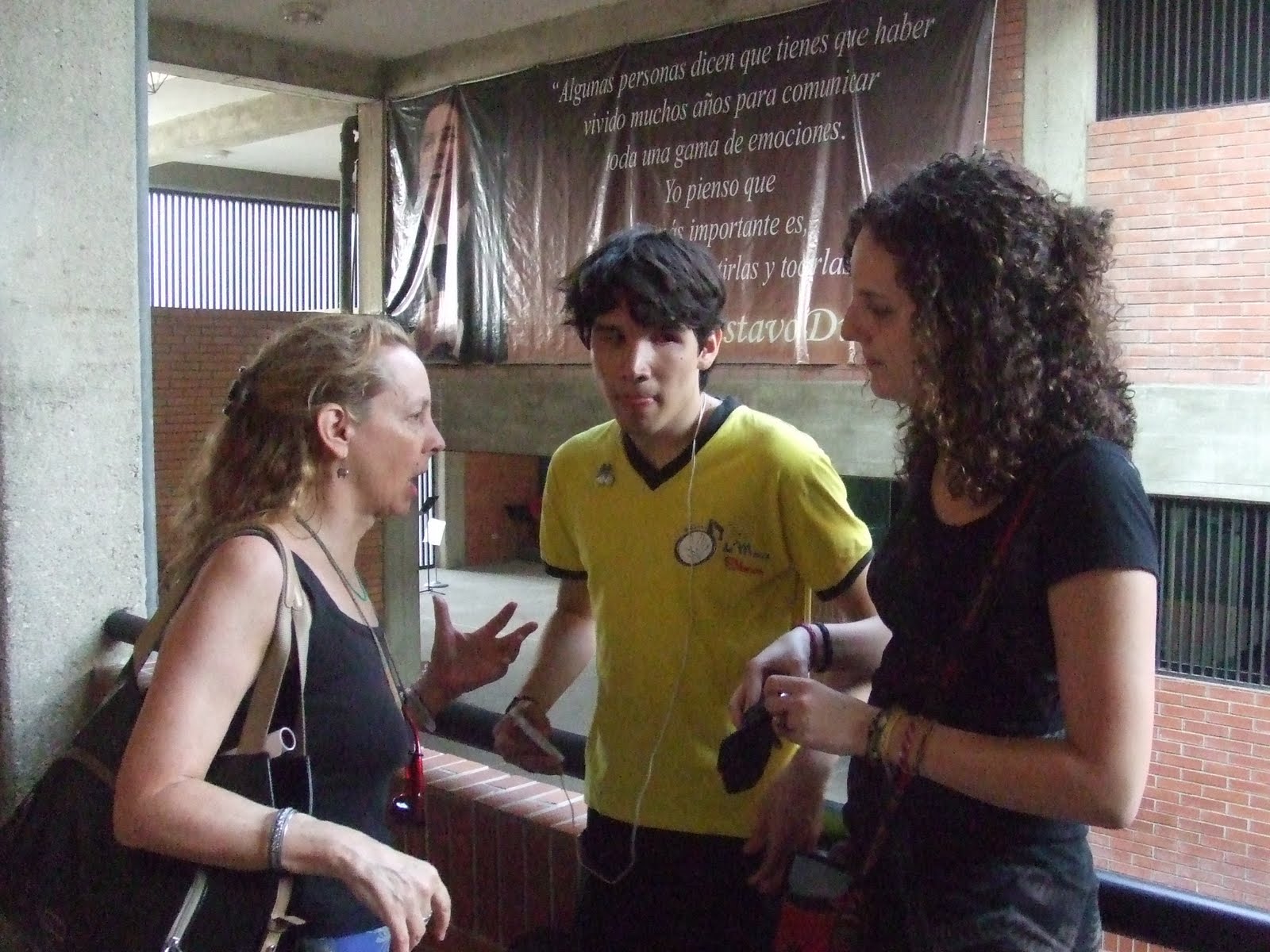
 With Dudamel as the backdrop, Rebecca and Jamie Bernstein talk to Daniel, a student at the Barquisimeto nucleo.

The Baby Choir warms-up singing solfege along with hand signs.

Gabriel demonstrates how he writes his music theory homework in Braille, punching hole by hole.

It's All In the Family: Many of Barquisimeto's teachers and staff grew up together in El Sistema, playing side-by-side in the orchestra as children. The feel of the nucleo, like many we have seen, is one of a big, happy family. Today as administrators and teachers, they remain close friends (some married to one another) and have a shared experience that provides a clear, unified vision for their work. Many also continue to play, striking what can be a difficult balance between being a musician and working as an administrator. For example, Alfredo can be found most mornings rehearsing with the Lara Symphony Orchestra, which prepares a weekly Thursday night concert. Conveniently, the rehearsal space is located at the nucleo, so after packing up his trumpet, Alfredo can walk across the parking lot and begin his administrative work before teaching in the afternoon and evening.

 Alfredo D'Addona stands outside the nucleo with the Abreu Fellows.
(below his wife, Libia, conducts the Symphonic Choir)


Partnerships: Barquisimeto is unique in that the nucleo shares its building with the Conservatory. With over 3,000 students attending the nucleo alone, space is limited. The inside courtyard handles the overflow beautifully and brims with musical activity in every corner. On Fridays, there is no symphony rehearsal because most of the players teach at the nucleo or conservatory. That teaching time is generally reserved for the highest-level students, many of whom travel from outlying areas to learn techniques that they can share with the less advanced students in their home orchestra.


 The inside courtyard of Barquisimeto nucleo

A cello sectional takes place in the reception area of the nucleo.

A percussion teacher holds an individual lesson in one of the corners of the courtyard.

On our last day, as we were finishing up our last meeting, we heard the sounds of an orchestra tuning up.  As we followed the sounds outside, we saw crowds gathering in front of a chorus made up of children and their parents.  We had no idea that the nucleo was preparing for the arrival of its city's patron saint.  But before long, the procession showed up, led by La Divina Pastora herself.   As I looked around at the musicians mixed in with the community members, I thought about the impact that Alfredo and his "family" have had on their city and feel grateful to have been a part of this nucleo for two weeks.  Muchas gracias para todo! 

Outside the nucleo, the orchestra and choirs prepare for the processional of Barquisimeto's patron saint, La Divina Pastora.


Sunday, March 28, 2010

Week 21: Early Childhood Programs - Never Too Early to Start

When I first started researching El Sistema, most of what I could find online was footage of the Simon Bolivar Orchestra and Gustavo Dudamel - both never cease to amaze me, but as an elementary music teacher, I wanted to know how they got there. What were these exceptional musicians doing at 5 or 10 years old in their local nucleo?

After observing ten different sites throughout Venezuela this past month, I now have a better picture of what their experiences might have looked like. Rodrigo Guerrero, International Affairs Coordinator of FESNOJIV, shared with me in Caracas that most of the nucleos begin their programs for children between the ages of 6 and 8, but that they hope to expand their programming to reach even younger children.

La Rinconada and Maracay are doing just that. These two nucleos are recognized for their early childhood programs, including classes for parents and toddlers. I also observed a Mozart Orchestra in Barquisimeto that had children playing brass and woodwind instruments as young as 4 years old! Like the miniature stringed instruments seen in most nucleos, Barquisimeto provides smaller brass instruments to fit the hands of these very young musicians. Even though you’ll see one or two students struggling with an instrument that’s just too big for them, it's been obvious to us throughout our travels that the nucleos are dedicated to meeting children where they are.

Before sharing a 3-minute movie clip highlighting the early childhood instrumental programs at La Rinconada, Barquisimeto and Maracay, I wanted to share a few observations:

Human Values: Cesar Rangel, the President of OSA (Orquesta Sinfonica de Aragua) shared this: "The magic of the system is human values. The orchestra provides that." The early musicianship classes focus on these values.  Children learn to take turns, respect their instruments and care for their fellow classmates.

Child-Size Instruments: Although the general rule across El Sistema for wind instruments is to wait until the child's permanent teeth come in, we saw children as young as 4 and 5 years old in Barquisimeto playing these instruments, miniature-sized. When asked how teachers deal with the "missing teeth" problem, the answer is: wait until the process is complete and then start up again. The recorder still plays an introductory role for wind instruments, as well as helps develop pitch discrimination for all of its young musicians.

Paper Orchestra Debate: Many of the teachers in the nucleos of both states of Lara and Aragua have not heard of the Paper Orchestra concept. When we explained that in Caracas the Paper Orchestra is used as a pedagogical step before a child plays an instrument (see La Rinconada posting for more details), one of the violin teachers in Maracay responded, " El Sistema is about getting instruments into the hands of children at an early age."  She felt that a paper instrument might confuse the child, rather than help prepare them.  Interesting contrast. So far, Caracas is the only place where we've seen the Paper Orchestra. 

Solfege and Singing: In an earlier post, I shared that the nucleos we've visited view singing as an important precursor to playing an instrument because it helps develop the ear. Singing and solfege continue to play a key role in the early orchestras as well. When practicing a melody or rhythmic pattern on their instruments, these younger classes alternate between singing lyrics, solfege and playing their instrument.

Parent Investment: Many of the baby classes have parents learning right alongside their child or participating in a parents only orchestra or chorus class. These classes have a specific purpose: to strengthen support at home for the child's musical development.

Student/Teacher Ratio: El Sistema's core value of investing early couldn't be more evident in their student-teacher ratio. Wherever we go, these young orchestras have on average a teacher or teaching assistant for every six children! Nucleos also invest in their young adults by giving them teaching roles and responsibilities. Becoming a teacher is a much sought after goal by these young musicians and considered quite an honor.

Saturday, March 20, 2010

Week 20: Cultural Exchange in the State of Aragua

Students Outside Cagua Nucleo

The staff and faculty of FESNOJIV (El Sistema) have been incredible hosts to the Abreu Fellows and have given us so much information and inspiration. Now in Aragua, we have a chance to give back.

While visiting five different nucleos throughout the state, Rebecca, David and I have been able to teach classes to students and adults, including a workshop in Maracay focused on singing games and dances for teachers coming from all over Aragua. These five nucleo sites are:

Cagua: We were fortunate to attend the opening ceremony of Cagua's new site along with their honored guest, Dr. Abreu! This nucleo has a very strong orchestra and Venezuelan Folk Music program, which is an extraordinary feat considering the students have been playing their instruments for just one year. The nucleo began in September 2008 in a school building across the street.

Colonia Tovar: This town was founded in 1843 by a group of German settlers who recreated their homeland in the Venezuelan mountains. The nucleo of 300 uses the university during the weekend and a church during the weekdays for its orchestra and choir rehearsals. One unique component of this nucleo is its lutiere training program for string instruments. With 21 students and 6 teachers, this workshop serves the entire state of Aragua.

La Victoria: While their space downtown is being renovated, this nucleo is being temporarily housed in a post-independence colonial home. With an enclosed courtyard and enough rooms to house 650 students, the nucleo echoes with the music of choirs, cellos and even electric cuatros. Rebecca, David and I were treated to mini-concerts throughout the center, including an early childhood program sung in English and Spanish.

Maracay: This nucleo has the most comprehensive program in Aragua and is recognized for its early childhood program. In one evening alone, we observed a toddler program (1 to 3 year olds) packed with moms and dads tapping sticks together with their child to the beat of Mozart; a beginning orchestra for parents learning alongside their child and a strings program for 1 to 6 year old children bowing a rhythm together on their miniature instruments. This strings program has 90 students enrolled with 30 of them still in diapers!

San Vicente: This nucleo is situated next to the largest garbage dump in the state of Aragua. San Vicente serves about 250 children, many whose families work in and live around the dump. After working in a building at the dump's entrance, the local government provided FESNOJIV with a building designed specifically for the community's musical needs, including beautifully hung artwork throughout the center.

Wherever we go, nucleo directors and staff have opened their doors to us, taken time to be interviewed, shared their programs and invited us to watch their classes. In return, Rebecca and I were thrilled to be able to share some of the musical songs, games and dances that my students back in Juneau, Alaska request over and over again. With Rebecca translating in Spanish, we taught at each nucleo and held an evening workshop for teachers from all over the state - some whom had traveled over an hour to get to Maracay. Thank you to both Alvaro and Rebecca for translating several of the songs into Spanish.

I'd like to dedicate this 3-minute video documenting our cultural exchange to the incredible teachers of the nucleos in Aragua, as well as to the staff and students at Glacier Valley Elementary School who will recognize the tune of these songs now sung in Spanish.

Teacher Workshop Participants in Maracay, March 2010


Sunday, March 14, 2010

Week 19: Latin Music - A Common Thread

After two weeks in Venezuela, the Abreu Fellows have visited many nucleos, attended concerts and met with key FESNOJIV administrators and teachers in Caracas, Guarico and Miranda who keep this incredible network of music centers operating and growing throughout Venezuela. Now in our third week, we've split into three groups to travel to different areas of the country. First stop:

State of Aragua: David, Lorrie & Rebecca; State of Guarico: Alvaro, Christine, Katie & Dan; and State of Merida: Dantes, Jonathan & Stan

My team is based in Aragua's capital of Maracay where we have visited four nucleos: La Victoria, Cagua, Maracay and San Vicente. In total, since arriving to Venezuela we have observed nine nucleos, all unique and reflective of their communities.

One surprising thread that I have seen running through all of the nucleos is Latin music. I was prepared to observe high caliber orchestras playing classical repertoire (and wasn't disappointed), but didn't expect to see equal attention paid to Latin classical and folk music. Without fail, every nucleo was incorporating some aspect of Latin influence - whether through dance, song, instrumentation or orchestral pieces. The joy, energy and enthusiasm that the students express when playing this music are contagious.

I've tried to capture this spirit in a short iMovie representing the nucleos I've visited. In less than 4 minutes, you will see fourteen unique experiences representing ages from three to thirty including:
  • youth choirs singing works by Venezuelan Alberto Grau, who incorporates movement into his compositions;
  • an electric cuatro as part of a duet;
  • Venezuelan folk music ensembles playing traditional instruments - Criolla harp, cuatro, mandolas, guitar, mandolin and maracas;
  • the White Hands Choir, composed of deaf students, who sign the words their peers are singing (See Christin's blog for more information on the special needs program in Guarico);
  • dancing violinists, cellists and horns and:
  • a 500-member performance of the Venezuelan national anthem integrating all of the diverse music programs offered in Guarico.
Muchas gracias, FESNOJIV, staff, faculty and students for inspiring all of us! Viva La Musica!

    Sunday, March 7, 2010

    What about Percussion, Woodwinds and Brass?

    A reader asked in an earlier blog, "At what point do students start learning wind and percussion instruments?" This has been a big question on the minds of the fellows as well. Back in Boston, we'd hear from varying sources that kids might start on brass and woodwinds as early as age six, but what about the challenges of developing lungs and missing front teeth?

    During our visits to the nucleos of Montalban and La Rinconada, I asked about this topic and was given answers specific to these two sites. One thing we are learning from our time here in Caracas is that nothing is written in stone and each nucleo is unique, so I preface by saying that this information is specific to Montalban and La Rinconada at this particular moment in time. El Sistema is flexible and continually responds to its students through a collaborative teaching process (see previous posting on this subject). Dantes and Jonathan also posted responses to Dr. Abreu's statement of "El Sistema as no system" in their blogs and both are worthwhile reading.

    Recorder and Choir: Laying the Foundation

    Percussion is a part of the early childhood classes from the beginning where they learn rhythmic and melodic notation and solfege in a fixed do system. Students also learn to play the recorder as early as five years old to help with intonation and pitch discrimination. The recorder serves as a precursor to the wind instruments. Generally, students don't begin playing a brass or woodwind instrument until they have their permanent front teeth - so it depends on the child.

    Oftentimes, it's the recorder that helps students learn to sing in tune. Half the students will sing, while the other half accompanies them on the recorder or everyone plays the first verse and sings the second. It's in these early childhood classes where the musical foundation is laid and discipline, focus and attention are developed to prepare for the demands of the orchestra rehearsal. Students who enter the nucleo at an older age need to sing in choir for one or two years before starting an instrument.

    Children Changing Instruments:

    Many of the fellows wondered what the process was regarding a child's wish to switch instruments. Rodrigo Guerrero explained that El Sistema allows children to change instruments, but the decision is taken seriously. Here are the steps:
    1. Teacher talks with the student to find out if his or her decision is based on a physical or attitudinal change and is more than just a casual thought.
    2. Student and instructor discuss the reasons with the nucleo director.
    3. If an instrument is available, the child has a trial period with the new instrument.
    4. Ultimately, the goal is student engagement.
      And engagement is what we are seeing at all levels throughout the nucleo. As these young musicians advance in skill level, there is an ensemble ready to meet them. In my posting on Montalban, I documented the orchestras offered there. In this video, you'll see a progression from the early musicianship class and two levels of recorder, to a choir and an advanced wind ensemble. It's a short video, so I hope you'll watch the very last clip of a recorder solo from a 5 year-old at Montalban.


      Saturday, March 6, 2010

      Week 18: The Abreu Fellows Meet Their Namesake

      As we travel to different nucleos throughout Caracas, we are discovering that each site is unique and flexibly adapts its planning to meet the  needs of its children and community.  In fact, Dr. Abreu himself explained that El Sistema is not a system, but rather a living, breathing program that continues to grow and develop through the collaboration of many generations of its teachers.

      The process may vary, but the goal set forth by Dr. Abreu is constant: "creating better human beings." This mission drives the decisions of its teachers and permeates the walls of every nucleo we visit. We hear it in the impassioned voices of the young nucleo directors and teachers (not much older than their students) and see it in the determined faces of children in the orchestra focused so intently on the music that they seem unaware of the crammed spaces and stifling heat. 


      Folks who had visited Venezuela and its nucleos told us the experience would be life-changing and now I see why:  it's become commonplace to enter a room of a nucleo and be deeply affected by music played in ensemble by hundreds of kids.  Each nucleo is living out Dr. Abreu's conviction that "the culture for the poor cannot be a poor culture."

      When we met Dr. Abreu last week, he confessed that he had created a scandal when he first insisted that El Sistema be enrolled in the Ministry of Social Development, rather than the Ministry of Culture.  He expressed to the President of Venezuela at that time that he wanted only one thing: "To have the state acknowledge that this (El Sistema) is a social program and as an artist, I demand that my art be dignified with the mission of creating better human beings."

      His teachers are living proof of that.  Having lived through El Sistema as children, they are now the young teachers and directors of the 180 nucleos across Venezuela.  Their collaborative teaching spirit creates an environment of constant learning and sharing, which is why we won't find a how-to-manual here.   Dr. Abreu left us with words I imagine he shares with any new nucleo director or teacher:
      We will not give you a manual or dictate what you should do.  What we want you to do is to live with us for a while in the most chaotic possible way.  See schools with different programs and look at the interactions of the orchestras and their community so that you can see how this happens, make a concept of your own and find a way to incorporate yourself as you see fit into the process.
      Thank you, Dr. Abreu and FESNOJIV for opening the doors of your nucleos to the Abreu Fellows. Your musical "chaos" is restructuring the way we think.

      Monday, March 1, 2010

      Week 17: Montalban - Witnessing Support Every Step of the Way

      After visiting the El Sistema nucleos of La Rinconada and Montalban, I feel as though I have witnessed the power of what Geoffrey Canada of the Harlem Children's Zone terms the "conveyor belt" strategy. This strategy focuses on providing children with a continuous network of support from infancy through high school so that progress made in one program is not lost in a gap of service between the next.

      From La Rinconada's Baby Vivaldi program for parents and their 2-year olds to the many nucleo youth orchestras varying in age range and skill, the goals among staff at all levels were quite clear: meet the children where they are and provide opportunities throughout their time in the nucleo to develop tools for life and to feel a sense of advancement through hard work.


      At Montalban, we moved from one room to the next, listening to the incredible performances of the different ensembles and experiencing first hand how each orchestra built and expanded upon the skills of the previous one. In just a matter of one hour, we had traveled through the musical life of a child attending Montalban from ages six through seventeen!

      Here is a short iMovie I created to document this progression:


      On Saturday, we returned to Montalban to watch the early childhood classes for ages three through six, a component of El Sistema that many of us are convinced is largely responsible for the high level of discipline and musical skill we are seeing in the older grades. As Frank di Pollo, one of the founding members of El Sistema put it, "That is the system - teaching 3-year olds. That's what is most important."

      James Heckman, Nobel Prize-winning University of Chicago Economics Professor, couldn't agree more. His research is referenced in Whatever It Takes, an account of the Harlem Children's Zone and validates many of El Sistema's objectives. He found that social skills such as persistence, attentiveness and impulse control when combined at an early age "help create capable and productive citizens."

      Much like we saw at La Rinconada, these young students were developing those same skills through play: waiting for the right moment in the song to shake their egg maracas, listening to the first few notes of a piece played on the recorder to see who could guess it's title and always making music together as a group. We saw all of these skills played out in more sophisticated ways in the older grades as intense focus on the music and conductor, waiting quietly for considerable amounts of time for another section to rehearse and playing passionately together as an orchestra.

      El Sistema has hit the mark on so many levels: from investing in early childhood and instrumental music to offering a consistent "conveyor belt" of services through after-school hours and ensembles that encourage children to advance.

      After gathering research from economists, sociologists, psychologists and neuroscientists for Whatever It Takes, author Paul Tough writes in the afterword why a program like the Harlem Children's Zone is so promising:
      To change the trajectory of a poor child in an inner-city neighborhood, this research shows, you need to: intervene early in the child’s life, continue to intervene throughout adolescence; give him extra time in school and extra support outside of school; involve his parents if possible but be prepared to compensate for their absence; focus on improving his cognitive skills but also nurture his noncognitive, social and emotional skills.
      This quote could very well be about El Sistema.

      Thank you, FESNOJIV, Rodrigo Guerrero and the staff and students from La Rinconada and Montalban for opening your doors to your classrooms, curriculum and our questions!

      Tuesday, February 23, 2010

      Week 16: La Rinconada: El Sistema's Oldest Nucleo

      For the next couple of days, the Abreu Fellows will be visiting La Rinconada Nucleo, which is located in the southern part of Caracas and was the first nucleo established by El Sistema in the 1970's. La Rinconada emphasizes early childhood programs, including one for toddlers and moms and a percussion class for children with special needs.

      When we arrived, a group of 4-year old children had just moved from the Paper Orchestra to playing a real stringed instrument. All of the fellows are fascinated by the Paper Orchestra concept. These beautifully homemade instruments are created by the child and parent to help develop respect, care and discipline for the stringed instrument that the child will eventually play. The paper instruments also allows kids to safely practice motor skills needed for bowing and handling, before the real instrument is placed in their hands. Students make the instruments at home with their parents for one month and then play them at the nucleo for two months leading up to a final performance. Then they are ready to move on to the real thing!

      Much of the pedagogy at La Rinconada developed out of practical need and trial and error. The talented teachers here constantly create and revise their teaching practice to meet the needs of their children, many who come from the outlying barrios. In fact the Paper Orchestra concept was born out of just such a practical need: after waiting months for the real instruments to arrive, the paper orchestra was created to get instruments into the hands of eagerly awaiting children.

      I had a chance to observe two classes of musicianship for 3 and 4 year olds. Movement and percussion instruments were built in to each song, with deliberate moments of silence, "rest position" and taking turns to develop discipline, focus and listening skills. One of the teachers explained that the primary goal of these musicianship classes is to develop discipline. After hearing from some of the fellows how unbelievably focused the 6 - 9 year old students were during an hour and a half orchestra rehearsal next door, I believe the teachers are accomplishing their goal.


      Here is a short documentary from Michael Uy who worked at La Rinconada for two weeks in 2008. He shares his experiences there and provides a wonderful summary and visual backdrop to this inspiring place.

      Monday, February 22, 2010

      Meeting Two of El Sistema's Ambassadors

      Where do you get to meet the world's leading conductors Gustavo Dudamel and Claudio Abbado on the same weekend? In Caracas, of course, celebrating the 35th anniversary of El Sistema. Both conductors are deeply committed to this inspiring youth music program and see youth mentorship as an essential part of a professional orchestra’s work. Their hope is that more orchestras throughout the US and Europe will take up the same charge and understand how important the musical development of youth are to the future of orchestras and symphonic music. Dudamel and Abbdado give their time and expertise to these young orchestras and are working to develop El Sistema programs in Los Angeles and Italy, respectively.

      Dudamel powerfully articulated the LA Phil’s commitment to youth music programs when he opened the LA Philharmonic season conducting students alongside LA Phil musicians. This gesture earned him ABC’s Person of the Week: Gustavo Dudamel's First Concert With the L.A. Philharmonic - ABC News

      The fellows hope to enroll more American symphonies in this important work. I was honored to meet Dudamel after an incredible performance of the Simon Bolivar A Orchestra (consisting of El Sistema teachers and founding members) and was able to share with him my plans to work with the community of Juneau, Alaska, to start an El Sistema-inspired program there.

      In keeping with El Sistema's philosophy of early access to instrumental instruction, our hope is to pilot an initiative at Glacier Valley Elementary School where all of the kindergarten classes will learn Suzuki violin alongside their teachers during the school day. I just wrote my first grant proposal to help fund the purchase of a classroom set of violins and am keeping my fingers crossed!

      I was able to present Dudamel with an Alaskan pin to signify that his advocacy of El Sistema USA is expanding to a northern neighbor in Juneau, Alaska.

      Maestro Abbado was kind enough to meet some of the fellows after a rehearsal with the Simon Bolivar B Orchestra, which will perform Tchaikovsky's Symphony No. 6 next Wednesday night. When I shared with the concertmaster of the Simon Bolivar B Orchestra how expressive and passionate the orchestra played together during the rehearsal, moving like waves across the stage, he said, "You haven't seen anything yet. Just wait for Wednesday night's performance." Here's a photo from their rehearsal. It's hard to capture the intensity and energy behind their playing in a still photo, but I can testify that I have never seen anything like it before in my life! I can't wait for Wednesday night!


      My colleague, Christine Witkowski, posted a beautiful reflection on the Saturday morning performance by the Teresa Carreno Youth Orchestra, made up of El Sistema musicians ages 12 - 16. I couldn't express our experience more eloquently. Please read her blog, Key Changes, describing this incredible orchestra.

      Friday, February 19, 2010

      El Sistema Celebrates 35 Years

      We arrived in Caracas just in time to celebrate El Sistema's 35th year anniversary. Tonight's the big night! Dudamel conducts the Simon Bolivar Youth Orchestra and there are rumors we may be able to meet both Maestro Dudamel and Dr. Abreu! With all of this excitement, the fellows are still very grounded in our purpose here in Venezuela. We are here because of a wish Dr. Abreu made when he won the 2009 TED Prize:
      "I wish that you help to create and document a special training program for 50 gifted young musicians passionate about their art and social justice and dedicated to bringing El Sistema to the United States and other countries."
      With the accomplishments Jose Abreu has made in Venezuela, I have no doubt that his wish will come true. The Center for Social Action Through Music (pictured above) is a physical testimony of his work. FESNOJIV (El Sistema) created this building to provide quality space for youth music academic programs especially those at-risk. This impressive center has 94 rehearsal rooms and two performance halls - the Simón Bolívar Hall, which seats 1,100 and the Concert Hall N° 2 with a seating capacity of 400. The walls, floors and ceiling are soundproofed and rooms are built with flexibility in mind, so that a meeting room can quickly be transformed into a performance or rehearsal space.

      Here's a slide show of the different spaces this beautiful center offers:


      Rodrigo Guerrero, International Affairs Coordinator of FESNOJIV, gave us a tour of the center and shared Dr. Abreu's goal for expansion:


      With six buildings like the center approved for other cities in Venezuela and 24 new nucleos scheduled to open next year, FESNOJIV is accomplishing Dr. Abreu's goal of providing 1 million students access to quality music experiences in their community.

      Thursday, February 18, 2010

      Week 15: Arriving in Venezuela!

      The moment the Abreu Fellows have been waiting for has finally arrived: we landed in Caracas to begin our two-month period of observation and study at various El Sistema sites throughout Venezuela.
      As guests of FESNOVJIV (El Sistema) or the National System of Youth and Children's Orchestras of Venezuela, the fellows will stay together as a group in Caracas for the first 10 days and then will spread out in teams of 2 or 3 to visit three different nucleos in outlying areas to continue our observations, as well as help teach.

      There are 180 nucleos operating in Venezuela, which are community-based and house choral and orchestral programs. Although the itinerary may change, Jonathan Govias and I are scheduled to visit the following communities, each for a two-week period: Maracaibo, Barquisimeto (home of Gustavo Dudamel) and San Felipe. Tomorrow we'll visit the Center for Social Action through Music and watch the Simon Bolivar Orchestra perform Mahler's Symphony No. 9 conducted by Dudamel! Until then...

      Saturday, February 13, 2010

      Week 14: Kids are Kids

      The most difficult part of being in the Abreu fellowship has been the lack of contact with kids.  I really miss the students at Glacier Valley Elementary School and have been searching for opportunities to work with children while in Boston. A good friend of mine, Irene Smalls is a children's book author and volunteers at a local Boston school in Rochester:  Nathan Hale Elementary School.  Irene created a program called Literacise, which integrates children's literature with physical movement, and she shares her lessons with classes at Nathan Hale.

      Irene arranged for me to visit the school so that I could work with some of the classes.  As soon as I entered the school grounds, I knew Nathan Hale was a very special place.  Volunteers greeted me at the door, positive messages adorned brightly painted walls and children's artwork hung proudly throughout the school.  The principal, Sandy Mitchell-Woods, is the driving force behind this incredible school.  She works alongside the community and parents to bring a variety of experiences to the students and was awarded Massachusetts Principal of the Year for her efforts.

      I decided to bring one of the Remo drums along with me on the subway and bus to share with the kids.  My first thought entering one of the kindergarten classes was:  would this school population of predominantly African-American and Latino students respond differently to the way I teach than those of Glacier Valley consisting of mostly Alaskan Native, Asian-Pacific and Caucasian students?  After visiting three different classes that morning, I came away reaffirmed that "Kids are Kids"  and that lessons filled with challenge, joy, teamwork, humor, goal-setting and a sense of accomplishment appeal to both child and adult learners.

      After we mastered the first skill, I'd announce, "Congratulations, you have reached Level I in drumming."  The question from the class that immediately followed was, "What's Level II?"  and with the answer came an eagerness from the class to achieve it.  From sitting up properly, holding a steady beat to tapping out a complex rhythm while singing an African song, the class was determined to reach higher levels of skill mastery.  By the end of the lesson, they had reached Level XII and you should have seen the pride in their faces.   We ended the session giving everyone a chance to improvise.  Here's a picture of one of the students - his face tells it all.

      Thank you, Sandy Mitchell-Wood, Irene Smalls and the entire Nathan Hale Elementary School community for welcoming me into your school.  Also, thank you Will Schmid and Remo Belli for your gift of drums, which continues to reach others beyond the NEC community.